
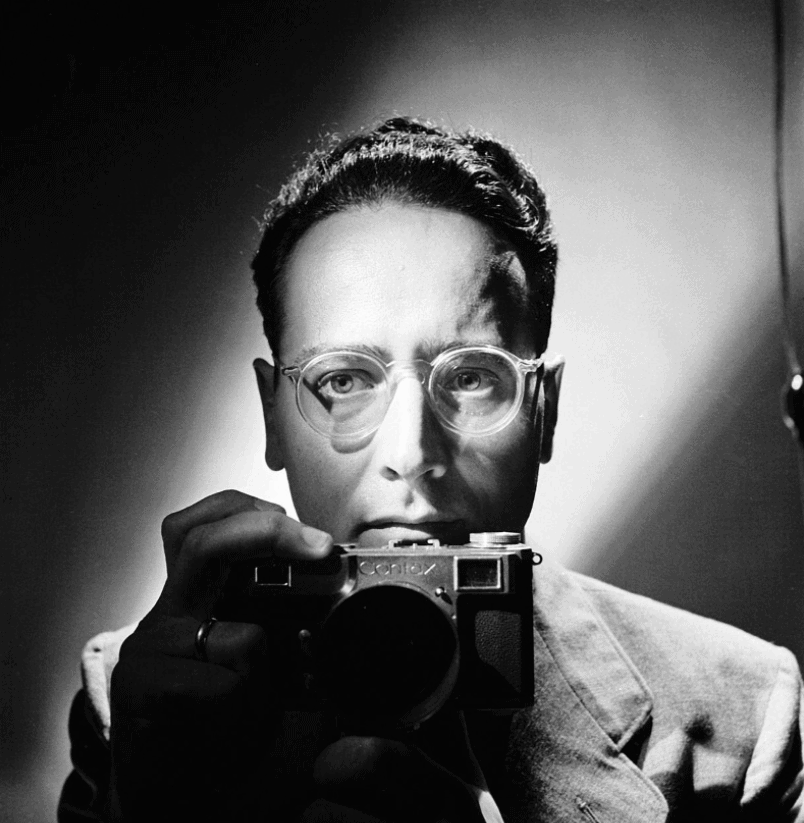
Feininger has been a significant influence in my early learning as a photo enthusiast. Not so much in terms of his images, but more through his authorship of various textbooks and manuals. His book, ‘The Complete Photographer’ was the standard text for my GCE photography course way back in 1974. His influence therefore in my technical knowledge was enormous and much of what I learnt then I still use today being that I regularly use manual settings even on my digital cameras.
Feininger was born in Paris, the eldest son of Julia Berg, a German Jew, and the American painter and art educator Lyonel Feininger His paternal grandparents were the German violinist Karl Feininger and the American singer Elizabeth Feininger, (née Lutz), who was also of German descent. His younger brother was the painter and photographer T. Lux Feininger.
In 1908 the Feininger family moved to Berlin, and in 1919 to Weimar, where his father took up the post of Master of the Printing Workshop at the newly formed Bauhaus art school.
Andreas left school at 16, in 1922, to study at the Bauhaus; he graduated as a cabinetmaker though he later was to study architecture. It was during this time that he developed an interest in photography and was given guidance by neighbour and Bauhaus teacher László Moholy-Nagy.
In 1936, he gave up architecture and moved to Sweden, where he focused on photography. Just prior to WWII, Feininger emigrated to the U.S. where he established himself as a freelance photographer. In 1943 he joined the staff of Life magazine, an association that lasted until 1962.
Feininger became famous for his photographs of New York. Other frequent subjects among his works were science and nature, as seen in bones, shells, plants, and minerals in the images of which he often stressed their structure. Rarely did he photograph people or make portraits.
Feininger was a prolific author and wrote comprehensive manuals about photography, of which the best known is The Complete Photographer. In the introduction to one of Feininger’s books of photographs, Ralph Hattersley, the editor of the photography journal Infinity, described him as “one of the great architects who helped create photography as we know it today.” In 1966, the American Society of Media Photographers (ASMP) awarded Feininger its highest distinction, the Robert Leavitt Award. In 1991, the International Center of Photography awarded Feininger the Infinity Lifetime Achievement Award.
To view images of some of Feininger’s work click here.
Quotes by Feininger
I personally find that as well as studying images of the great names in Photography, it is also well worth reading photographic quotes about what they have to say on the subject. For me Feininger is a wonderful example to study. Think on what he has said and consider your own practice especially in the new wild world of digital cameras, mobile devices and ‘chimping’! I always try to think that I have a roll of film rather than a digital sensor and an endless supply of SD cards.
No one can do inspired work without genuine interest in his subject and understanding of its characteristics
The first impression of a new subject is not necessary the best. Seen from a different angle or under different condition it might look even better. Always study a three – dimensional subject with one eye closed
Realism and super-realism are what I’m after. This world is full of things the eye doesn’t see. I mean even the eye of a sensitive person. The camera can see more, and often times, better.
The photographer has almost as much control over his subject matter as a painter. He can control light and shade, form and space, pattern and texture, motion and mood, everything except composition.
Light is the photographic medium par excellence; it is to the photographer what words are to the writer; color and paint to the painter; wood, metal, stone, or clay to the sculptor.
As an amateur you have an advantage over photographers – you can do as you wish… This should make amateurs the happiest of photographer.
The camera can push the new medium to its limits – and beyond. It is there – in the “beyond” – that the imaginative photographer will compete with the imaginative painter. Painting must return to the natural world from time to time for renewal of the artistic vision. The key sector of renewal of vision today is the new vistas revealed by science. Here photography, which is not only art but science also, stands on the firmest ground.
(1) The more thoroughly a photographer explores his subject with the camera (i.e., the more pictures he makes), the more he sees and the better his chance of getting good results.
(2) Even slight changes in subject approach can make significant differences in the effect of the picture.
Two factors thus emerge as requisites of success in the field of creative photography. First, the subject must be photogenic. Second, its re-creation in a photograph must be based upon technical knowledge, guided and supported by artistic inspiration.
What matters is not what you photograph, but why and how you photograph it. Even the most controversial subject, if depicted by a sensitive photographer with honesty, symphathy, and understanding, can be transformed into an emotionally rewarding experience.
Any good photograph is a successful synthesis of technique and art.
The difference in “seeing” between the eye and the lens should make it obvious that a photographer who merely points his camera at an appealing subject and expects to get an appealing picture in return, may be headed for a disappointment.
With a short lens I can reveal the hidden things near at hand, with a long lens the hidden things far away. The telephoto lens provides a new visual sensation for people: it widens their horizons and, conversely, the things under our nose invariably look good when blown up really big.
Once a photographer is convinced that the camera can lie and that, strictly speaking, the vast majority of photographs are “camera lies,” inasmuch as they tell only part of a story or tell it in distorted form, half the battle is won. Once he has conceded that photography is not a naturalistic medium of rendition and that striving for “naturalism” in a photograph is futile, he can turn his attention to using a camera to make more effective pictures.
Photographers — idiots, of which there are so many — say, “Oh, if only I had a Nikon or a Leica, I could make great photographs.” That’s the dumbest thing I ever heard in my life. It’s nothing but a matter of seeing, and thinking, and interest.
Perhaps the most iconic image from Feininger’s portfolio showing the photojournalist Dennis Stock. Arguably, it may be Feininger’s best-known photograph; he took it for Life Magazine in 1951.
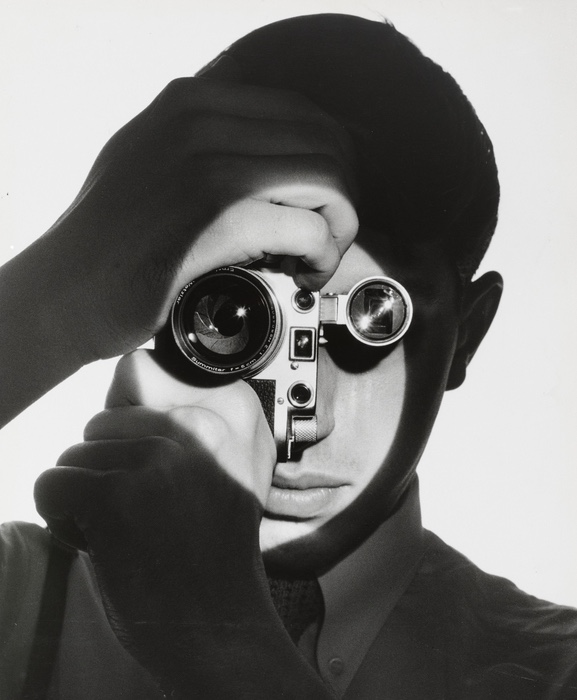
The Photojournalist, 1951. Feininger. © Time Inc.